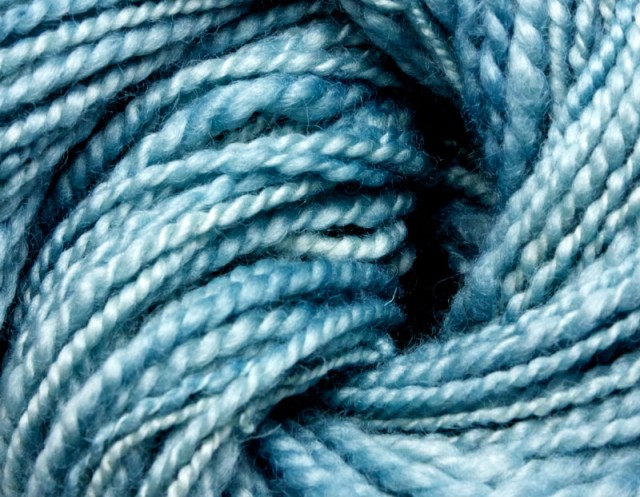
Blue is consistently one of the most popular colors in America.
Indigo is an ancient dye, still used around the world to create a range of amazing blues, from baby to deep azure. Indigo is not soluble in water, so cannot be immediately absorbed by fibers. Dyeing is a process involving reduction of the dye material to remove oxygen, then by exposing the fabric to oxygen, the dye turns blue. An indigo dyebath is a yellow green with silvery gunk floating on it. As items are dipped in the mucky yellow green mixture, then exposed to air, they become blue; like magic.
To most Americans – indigo is the color of blue jeans. You can still get naturally dyed jeans for over $250.00 a pair from a few designer companies. Levis Strauss began using synthetic indigo in the production of jeans in the late 1800’s, followed by a variety of additional treatments to get a wider range of blues and fabric finishes, many of which are very harmful to the earth and the people involved in the productions of jeans.
Indigo was domesticated in India, and spread through the world via the trade routes. Though expensive and rare, blue was generally the color of work clothes during the middle ages. Not until the rennaisance did blue become popular, partly due to the development of woad dyeing in England. Woad is a fast growing weed throughout Europe. Identical in chemical makeup to indigo blue, woad makes a weaker cheaper blue dye. Woad is listed as a Class A “noxious weed” across much of the U.S., thus cultivation is not allowed.